Intercompany amounts
The Interco Amounts tab is where you enter intercompany transaction data for your companies. It includes three sub-tabs — Intercompanies, Participations, and Partners — each designed for a specific type of transaction. You switch between them using the Filter buttons at the top of the page.
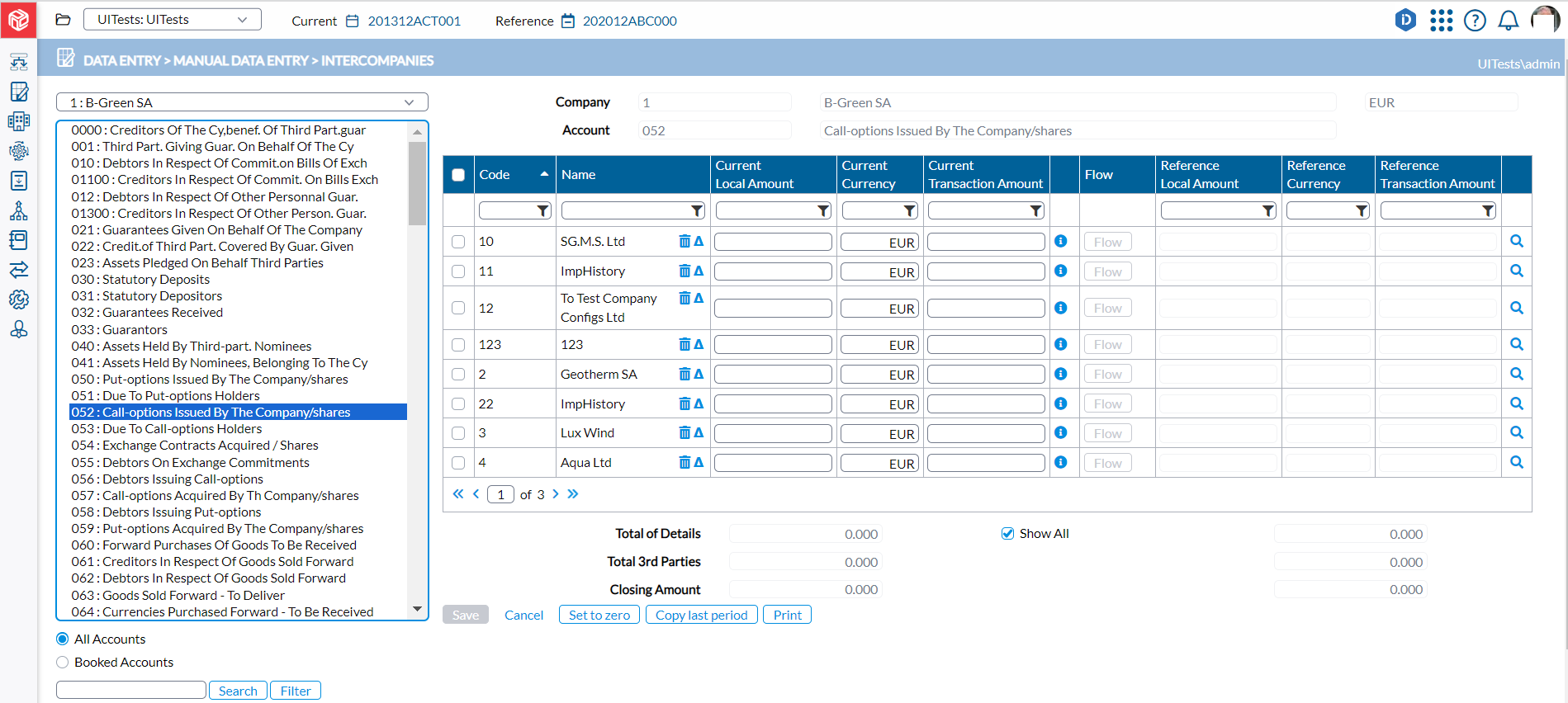
Although each tab serves a different purpose, they share the same page layout, fields, and table structure. The shared elements are described below. Any differences specific to a tab are noted in the instructions for that tab.
To access the Interco Amounts page, click  Data Entry > Data Entry > Interco Amounts tab.
Page layout and common elements
Top section
The following fields and controls appear on all three tabs.
Company: Select the company you are working on from the drop-down list. Only companies available to you are shown.
Currency: Displays the currency of the selected company.
Filter: Use the filter buttons to control which accounts appear in the Account drop-down. Select a filter based on the type of intercompany relationship you want to work with.All — Displays all available accounts, regardless of relationship type.
Intercompanies — Displays accounts associated with intercompany transactions between entities within the group.
Participations — Displays accounts associated with participation relationships, such as investments or equity holdings between group entities.
Partners — Displays accounts associated with partner entities outside the group.
Account: Displays the intercompany accounts relevant to the selected filter.
Show:
All Accounts — Displays all intercompany accounts. This is the default.
Booked Accounts — Displays only accounts that have data entered for the selected company.
See all lines / See only lines with amounts
See all lines — Displays all rows in the table. This is the default.
See only lines with amounts — Displays only rows that contain data.
Additional functions
 — Replaces selected values with zero. Use the checkboxes in the first column to select one or more rows. No warning appears after you click this button. You must save to confirm the change.
 — Copies amounts from the reference consolidation period into the current period. Use the checkboxes in the first column to select the rows to copy.
Export — Exports the table data to an Excel file.
 — Shows or hides specific columns in the table.
Data table
The table displays the following columns. The data shown reflects your selections above.
Each column has a filter field below the header. You can use the wildcard characters * and ? to perform searches within any column filter.
| Column | Description |
|---|---|
| Code | The intercompany code. |
| Name | The intercompany name. |
| Current Local Amount | The transaction amount in the local currency of the parent company. |
| Current Currency | The local currency of the parent company. Used to identify whether an intercompany difference is due to currency conversion or is a real difference. |
| Current Transaction Amount | The transaction amount. Enter this amount (not the local amount) to accurately identify the source of any intercompany difference. |
| Reference Local Amount | The local amount from the reference consolidation period. |
| Reference Currency | The currency from the reference consolidation period. |
| Reference Transaction Amount | The transaction amount from the reference consolidation period. |
Actions column
Each row in the table includes the following action icons:
| Icon | Description |
|---|---|
 | Difference. Allocates the remaining amount to a partner without manual entry. |
 | Clears the content of the selected row. |
 | Import details viewer. Opens the import data details. |
 | Intercompany Viewer. Opens a view where you can see existing transactions for the selected account. The left panel shows transactions entered by your company; the right panel shows the matching transactions entered by the counterpart. |
 | Launches Intercompany Management. |
Footer
After you save your entries, the following totals appear below the table:
Total of Details — The total of all entered values.
Total 3rd Parties — The total value of transactions with companies outside the group. This amount must be transferred to a specific account and must equal zero.
Closing Amount — The closing amount used in the balance sheet input form.
Enter Interco amounts
Use the Interco Amounts tab to enter transaction data for intercompany, participation, and partner accounts. The steps below apply to all three transaction types. Where the steps differ by type, the relevant tab is noted inline.
Select the applicable Company.
In the Filter field, select the tab that matches the transaction type you are entering: Intercompanies, Participations, or Partners.
Select the intercompany Account. The drop-down lists all intercompany accounts used for reporting transactions for the selected company.
In the table, select the company associated with the transaction.
Enter the transaction amounts:
Intercompanies tab: Enter the amount in the Current Local Amount field, then enter the transaction amount in the Current Transaction Amount field.
Participations and Partners tabs: Enter the Current Local Amount and Current Transaction Amount directly, or click the Flow button to open the Interco Flows page and enter flow data. On these tabs, the amounts entered directly are for information only and are not used for currency conversion.
For Intercompanies tab only: Optionally, click the Intercompany Viewer icon to review existing transactions for the selected account.
For Participations and Partners tabs only: If dimensions are linked to the account, a Dimension button appears beside the Flow button. Click it to open the Analytical Dimensions page and enter dimension data.
8. Save your input.
Note: For participation transactions, the system automatically eliminates all participation values during consolidation. This is because a parent company’s shares are treated as part of the subsidiary’s equity, ensuring the consolidated balance sheet reflects an accurate view of the group’s overall financial position.
 See also