Group adjustments: manual input
Use manual input to create a group adjustment, which is a journal entry made at the group level.
Open the Adjustments page
-
In the left navigation, select
 Adjustments. The Adjustments tab opens with a table of existing journals in the Current period by default.
-
In Period, select Current or Reference to choose which period to view.
The table shows the journal type, journal entry number, company, journal text, modification date, and approval status for each journal.
What you can do on the Adjustments page
From this page, you can do the following:
-
Add a journal entry. Click the
 icon to open the manual input page. See Add a group adjustment.
-
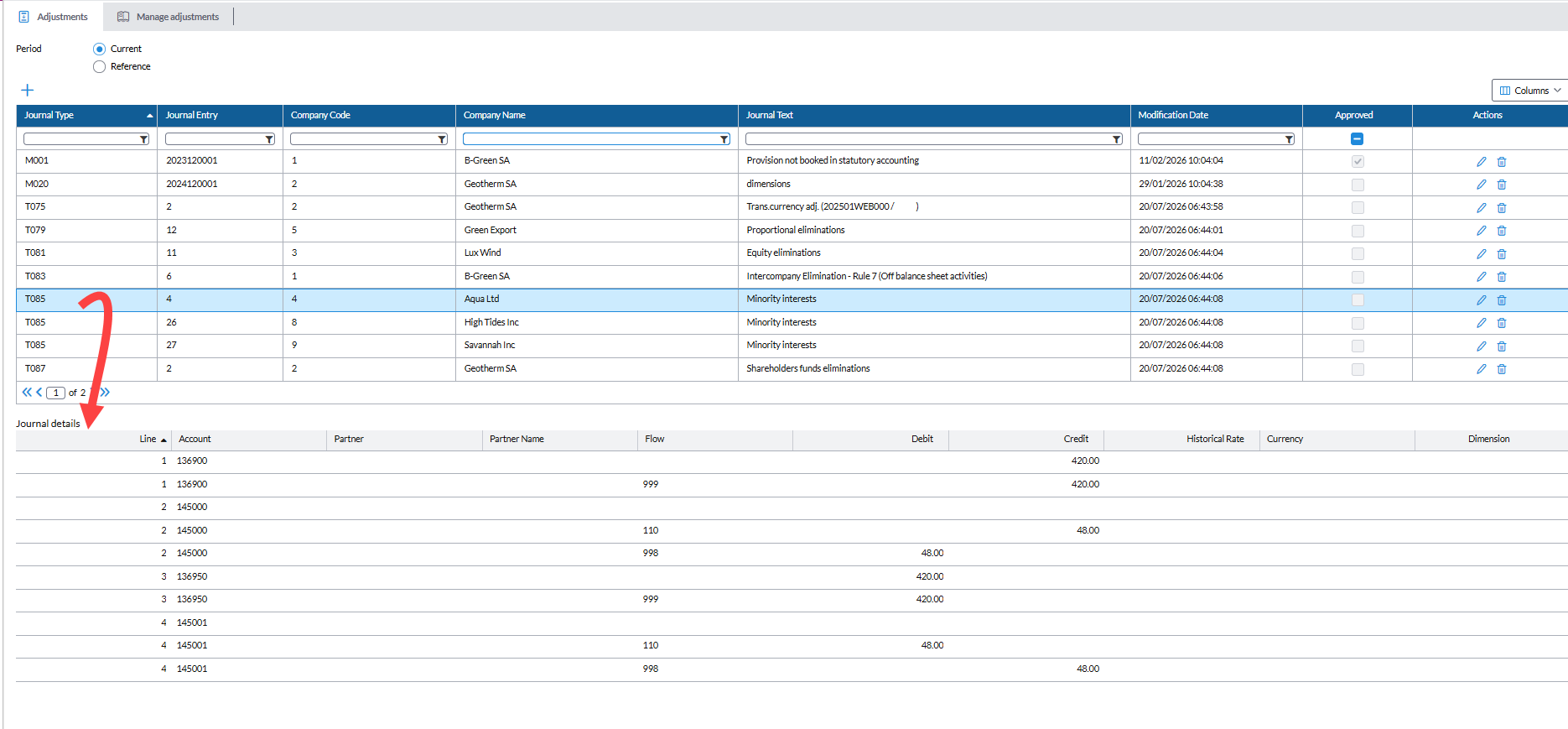
Preview journal lines. Select a journal in the table. The lines for that journal appear in the Journal details table below. See Preview journal lines.
-
Open a journal. In the Actions column, click
 to open the journal details window for the selected journal. See View and edit Journal details
-
Delete a journal. In the Actions column, click
 to remove the selected journal from the table.
Add a group adjustment
-
On the Adjustments page, click
The manual input page opens.
-
Enter the journal information.
Field Description Company
The company code and name. Enter a code or click the drop-down arrow to search.
Journal
The journal code and name. Enter a code or click the drop-down arrow to search.
Associated Journal
The journal that the adjustment carries forward into. This field fills in automatically when you select a valid company and journal. To use a different journal, click the drop-down arrow to search.
Journal Entry
The number the system assigns to the adjustment. This also fills in automatically. You can change it.
Journal Text
A description of the journal.
Currency
The currency for the adjustment, either Local Currency or Group Currency.
Third Party
When the adjustment applies, either Before or After third party calculations.
Behavior
The action to perform with the adjustment, such as carry forward to reserve, copy, or reverse.
Attachment
A file to add to the adjustment. This field is available only if attachments are enabled.
-
In the Sort by drop-down, select how to sort the lines: Line Number, Balance Sheet Accounts, or Profit & Loss Accounts.
-
If a tax applies, enter the tax rate in the Tax field and click Apply. The system adds lines with the calculated Deferred Tax, based on the tax rate and the specific accounts.
Add lines to the adjustment
-
Click
 .
-
Use the table below the header section to enter the details of the adjustment. Enter the following information for each line.
Column Description Line
The line number. This is assigned automatically.
Account
The account code and description.
Partner
The partner code. This applies only to intercompany accounts.
Flow
The flow code. This applies only if the account is set up to use flows.
Debit
The debit amount.
Credit
The credit amount.
Historical Rate
The currency exchange rate at the time of the transaction for the data line.
Transaction Amount
The transaction amount. This applies only to intercompany accounts.
Currency
The currency code. This applies only to intercompany accounts.
Dimension
Opens the analytical dimension information for the period.
Note: The
 button in the Dimension column becomes available after you save the entry. It works only if Financial Consolidation Analytical Dimensions is set up and the account is defined to use analytical dimension information.
At the bottom of the table, the Transaction Summary shows the total debit, total credit, and the difference for the lines you entered.
Work with lines
Use these options to manage the lines in your adjustment.
-
Add more lines. Click
to add a new set of rows at the bottom of the table. -
View totals by account. Click
 to open a window showing the debit and credit totals for each account.
-
Multiply or divide amounts. Select the lines you want to change, and then click
 . In the window that opens, enter the value to multiply or divide the selected amounts by. See Multiply or divide an adjustment.
Actions
The Actions column has three buttons for each line:
-
 Repeat. Copies the amount from the current line. This helps when a journal entry uses the same amount for several accounts as a debit or credit in turn. You do not need to retype the amount on each line, and it reduces entry errors. See Repeat an amount.
-
 Difference. Inserts the difference between the total debit and total credit amounts on the line where you click it.
-
 Clear. Clears the content of the line
Save the adjustment
-
When you finish entering the adjustment, click Save.
-
After you save, the buttons below the table become available:
-
 Add new journal entry. Starts a new, blank adjustment.
-
 Add new journal entry as current. Starts a new adjustment that copies the layout of the current one, including the selected accounts and flows.
-
 Delete journal entry. Deletes the saved adjustment.
-
-
Use the arrows next to the page number to move to the previous or next group adjustment.
-
To return to the Adjustments page, click
 .
Note: If you click without saving, you lose all of your changes.
Approve an adjustment
The Approved check box marks an adjustment as ready for consolidation. A consolidator or administrator selects it after reviewing all the adjustments an end user made. After the adjustment is approved, the data is locked and the end user can no longer change it.
To include only approved adjustments in a consolidation, select the Include only Approved user journals option in System Configuration.
Generate a report
-
Below the table, select a report format from the drop-down: PDF, XLS, or XLSX.
-
Click
 .
-
When the report is ready, a download link appears below the button. Click the link to open the report in the format you selected.
Multiply /divide an adjustment
Use button during a monthly reporting. It lets you quickly recalculate a provision, depreciation, or similar amount to the year-to-date value. The button works on all the lines you select.
-
Select the lines you want to change.
-
Click
. The Multiply/Divide pop-up appears. -
Enter the fraction by which you want to multiply or divide the amounts.
-
Click
 . The amounts are recalculated.
-
Click
 to save the adjustment.
Repeat an amount
Use the Repeat button to fill the amounts on all lines of an adjustment from one amount. The new amounts alternate between debit and credit.
-
Enter the amount you want to repeat on any line.
-
Select the amount, and then click
. The amount is copied to the other lines. Note: For the amounts to alternate correctly between debit and credit, enter the accounts in the order that matches this pattern.
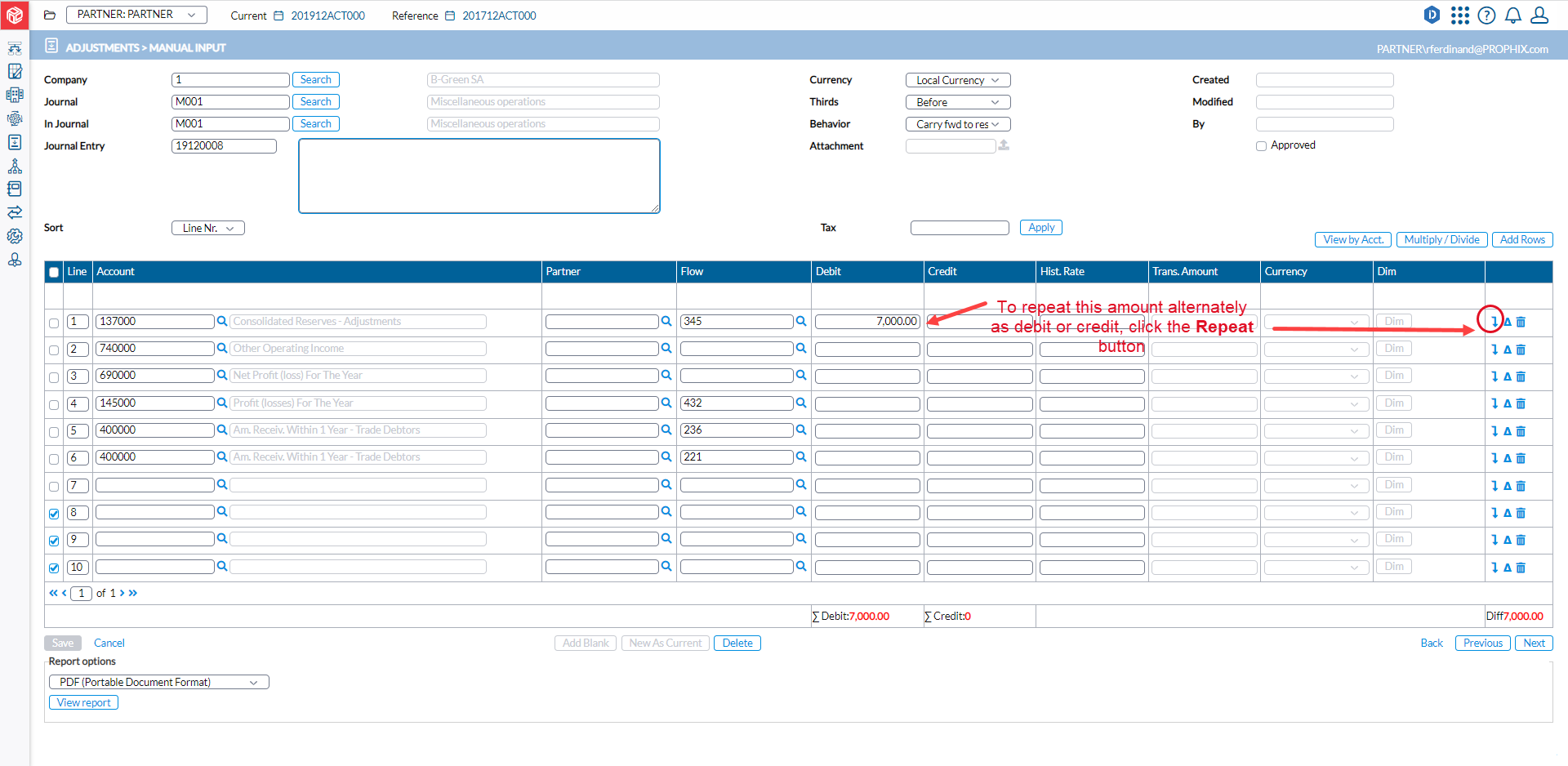
The following image shows the result after you use the
Repeat button.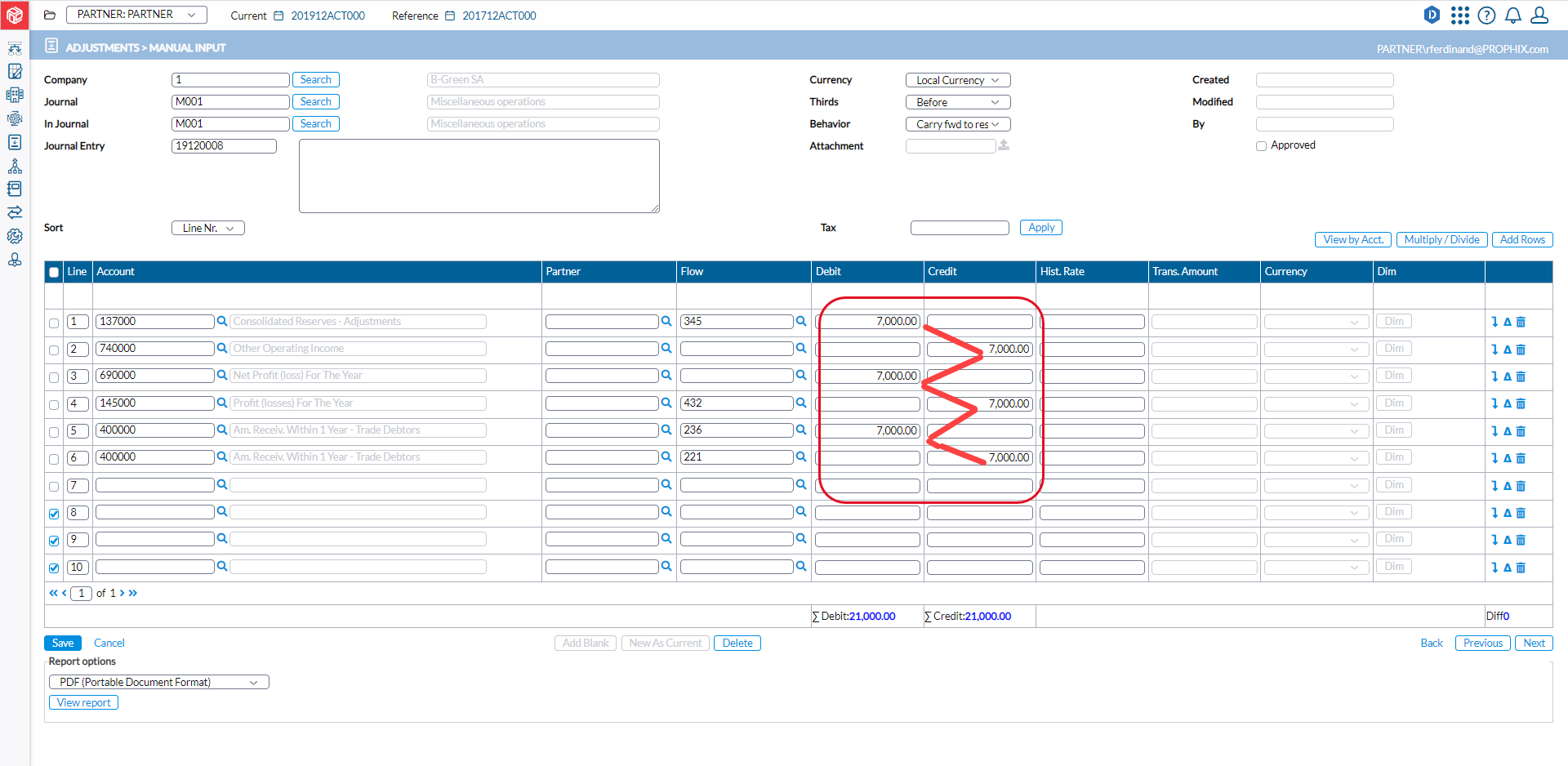
Use the Difference button
Use the Difference button to balance an adjustment.
-
Select the line where you want to insert the difference.
-
Click
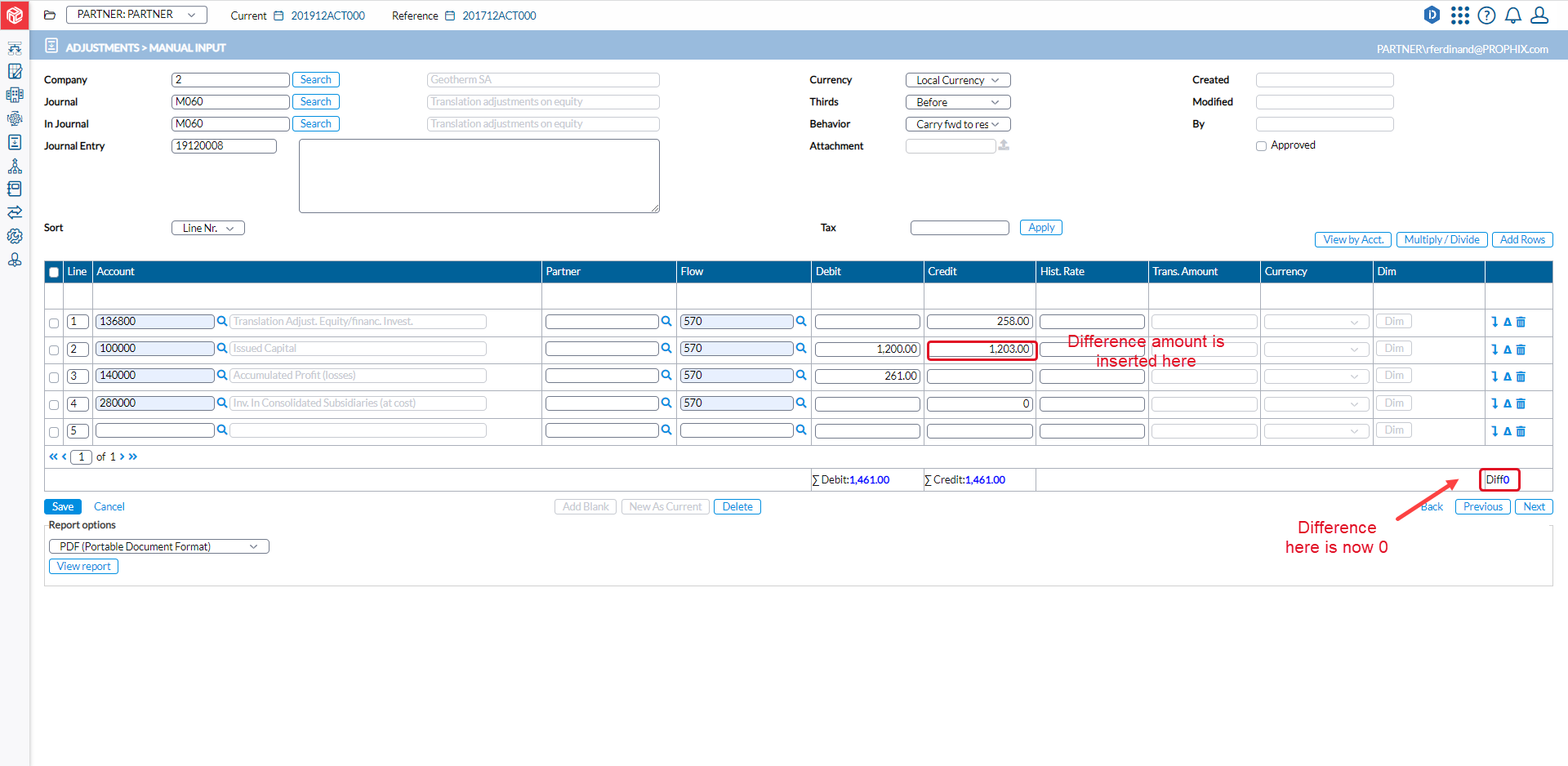
. The amount in the Difference field below the table, for example 1,203.00, is inserted into the selected field.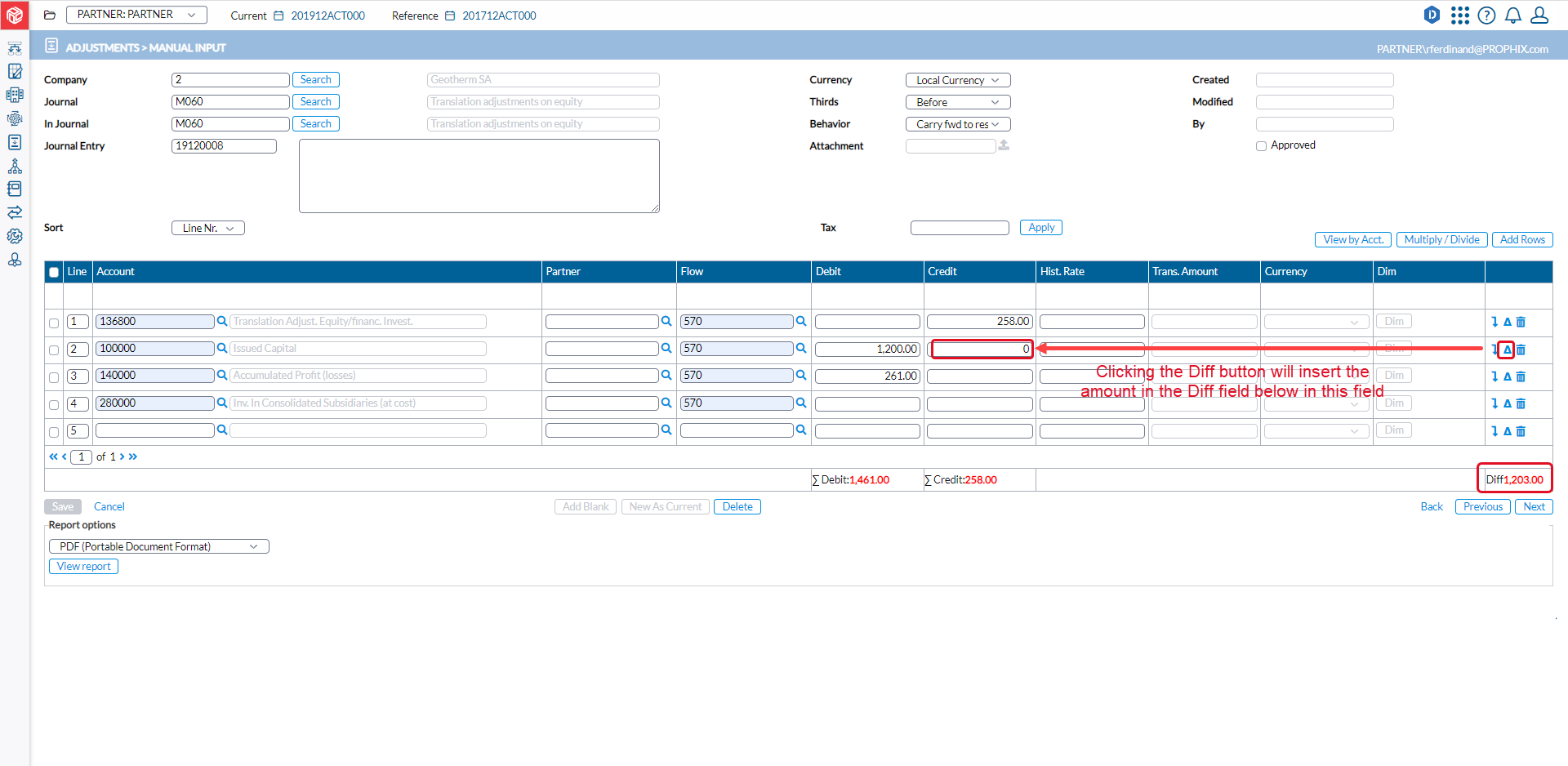
After you click Difference, the Difference field changes to 0 in this example, and the adjustment is balanced.
Preview journal lines
To display the lines in a journal, select it in the table The details appear in the Journal details section below the table.
View and edit full journal details
You can open an adjustment to see and edit its full journal details, unless your system administrator has restricted changes.
Note: Your system administrator may restrict changes to carried forward adjustments. These adjustments remain visible but cannot be edited. This protects historical data from previous year. For details, see Carried-forward adjustments.
-
In the Adjustments table, select the adjustment row and then, click
. The journal entry details appear on the Adjustments tab. The page shows fields such as Company, Journal, Journal Entry, Journal Text, and Currency. It also shows each account line in the entry. A summary box in the top right shows who created the adjustment and when it was created. It also shows the Modified and Approved details, and whether the adjustment is approved or carried forward. -
Select the line of adjustment you want to edit. If the adjustment is blocked, you cannot select the line for editing.
-
Make the necessary changes. For field descriptions, see Add a group adjustment.
-
Click
to apply your changes.
Audit summary of the adjustment
The box in the top right of the header is an audit summary for the adjustment. It shows:
-
Created: the user who created the adjustment, with the date and time.
-
Modified: the user who made the latest changes to the adjustment, with the date and time.
-
Approved: user who approved the adjustment, with the date and time
-
Approved and Carried Forward check boxes: they show the status of the adjustment.
Carried-forward adjustments (read-only)
Your system administrator may prevent changes to carried-forward adjustments. When this setting is turned on, all adjustments still appear on the Adjustments view page. However, carried-forward adjustments will work differently.
If you click on a carried-forward adjustment, the page opens in read-only mode and appears grayed out — similar to adjustments shown in the Reference period.
When this feature is enabled, you cannot:
-
Modify carried-forward adjustments
-
Delete them on the view page (buttons are disabled)
-
Access them through the Adjustments > Manage Adjustments page
During imports, if a journal entry in the file matches an existing carried-forward adjustment for the period, the system will display an error.
For linked subgroups, historical exchange rates for carried-forward journals are preserved. The main group does not overwrite subgroup entries with new rates, even when the group uses a different currency.
View analytical dimension of a reference period
-
In the Period panel of the Adjustments page, select Reference .
-
Select the adjustment you want to view and click
in the row. The view page for the selected adjustment is displayed. Tip: Clicking the adjustment displays its Journal details in the table below.
-
On the view page, click a line of adjustment where the
button is activated. Note: This button is activated only if the Financial Consolidation Analytical Dimensions function is configured and the account is set up to use Analytical Dimension information.
The Analytical Dimensions for the reference period is presented. All information is read-only except for the Dimension Group field.